Winner, Kelley AI PM Hackathon 2025
Turning dense MBA coursework into personalised, adaptive learning
Overview
An AI study copilot for MBA students
Jesa AI is an AI-powered study copilot designed to help MBA students move beyond AI-generated summaries toward deeper understanding and long-term knowledge retention. Built during the Kelley AI PM Hackathon, Jesa transforms uploaded course materials into personalised quizzes, adaptive flashcards and multilingual video explainers that adapt to each student’s learning progress in real time.
Problem
Summarisation isn’t the same as learning
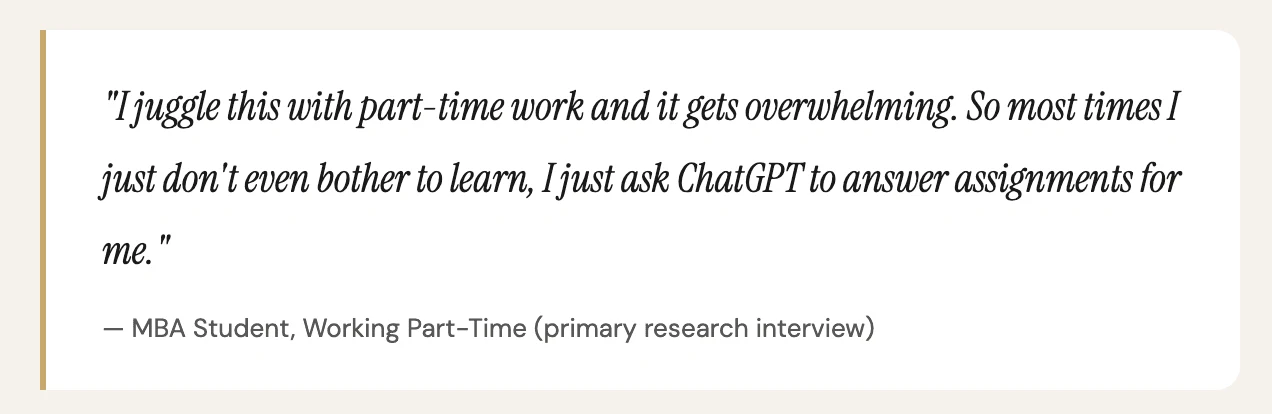
MBA students are expected to absorb large volumes of complex information while balancing recruiting, networking, leadership responsibilities and coursework. As these demands increase, many turn to AI tools to summarise readings, lecture notes and case studies simply to keep up.
While AI helps students consume information faster, it rarely helps them understand, retain or apply that knowledge. Students often finish reading a summary without knowing whether they’ve truly mastered the underlying concepts. We framed this as a knowledge assimilation problem, and that’s the challenge we set out to solve with Jesa AI.
Research
Ten student interviews revealed three recurring pain points
To validate whether this problem extended beyond our own experience, I conducted ten semi-structured interviews with Kelley MBA students.
- Dense course materials that lacked adaptive explanations for different levels of prior knowledge.
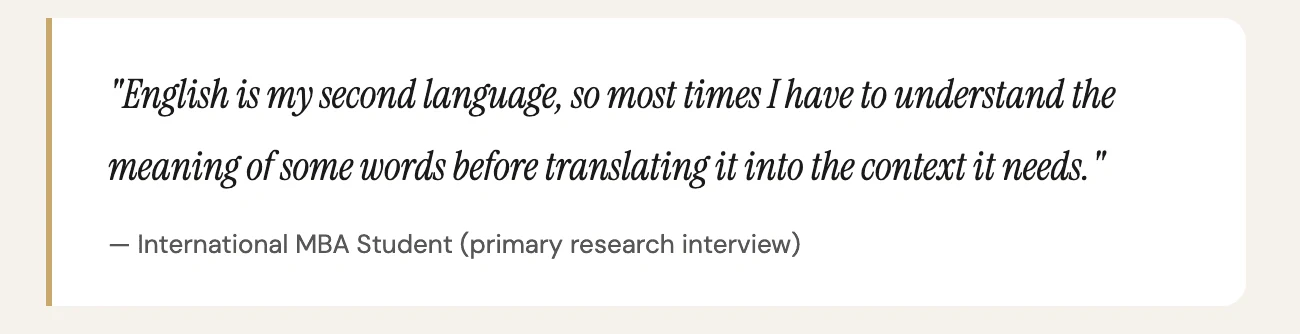
- Technical concepts that were particularly challenging for career-switchers and international students, who often needed additional context beyond lectures and readings.
- A fragmented learning experience, with students switching between multiple AI tools for summaries, flashcards, quizzes and video explanations instead of having one study workflow.
We also benchmarked existing solutions such as ChatGPT, NotebookLM and Quizlet. Each excelled at specific tasks. None combined grounded content generation, adaptive learning and multimodal study formats within a single workflow built around a student’s own course materials.
Solution
Our solution
Jesa AI ingests any course document (PDF, DOCX, PPTX) and transforms it into a complete, adaptive learning system.
The adaptive difficulty engine uses Item Response Theory (IRT) via scikit-learn to continuously calibrate quiz difficulty based on each student’s performance. The Retrieval-Augmented Generation (RAG) framework ensures the AI only cites content from the student’s own uploaded document. This removes the hallucination risk that makes general-purpose tools like ChatGPT a poor fit here.
Product and AI architecture
Product and AI architecture
I led the product strategy, authored the PRD and defined the end-to-end AI system architecture to align technical implementation with the product vision.
- Document ingestion
- Content preprocessing
- AI generation
- Post-processing and validation
- User experience
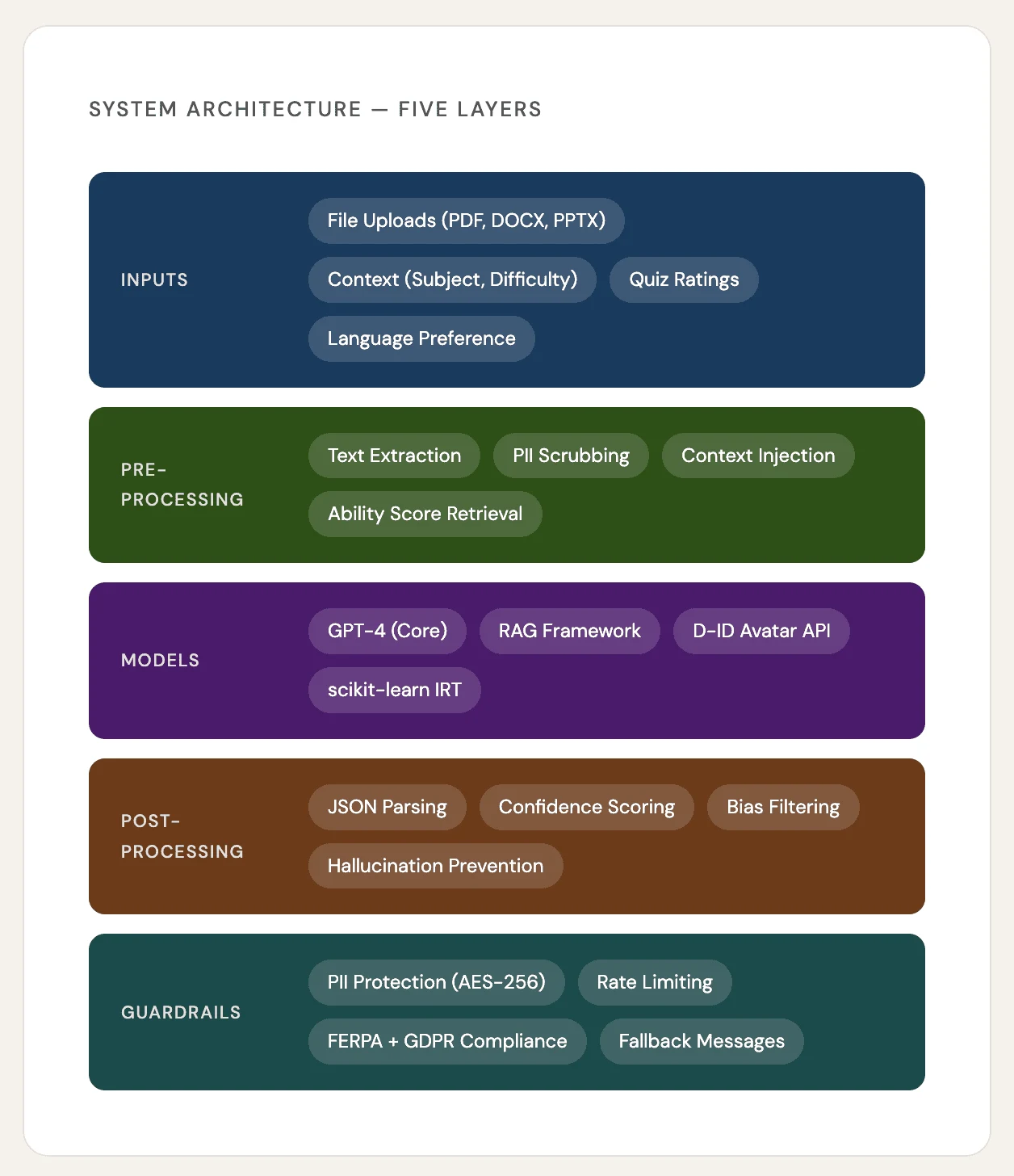
Grounding responses with RAG
Every AI-generated output is grounded in the student’s uploaded course materials. This significantly reduced hallucinations and made explanations, quizzes and flashcards traceable to source content.
Adaptive learning
Instead of presenting identical questions to every student, Jesa adjusts quiz difficulty using IRT. As students show mastery, questions get harder. When they struggle, Jesa adds reinforcement.
Metrics
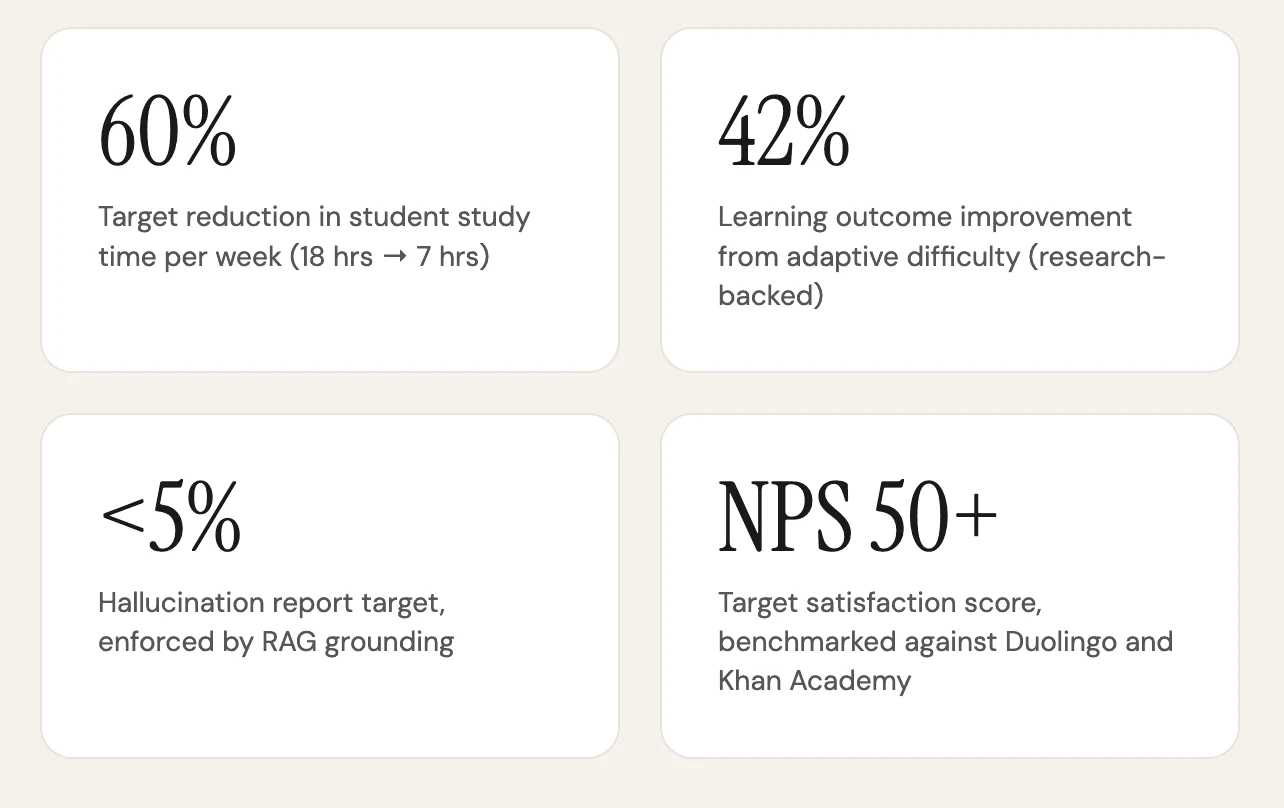
The success metrics we designed for
Reflection
What building Jesa taught me about AI product strategy
Winning the Kelley AI PM Hackathon validated the approach, from how we researched the problem to how we designed the solution. Beyond the win, building Jesa sharpened how I think about AI product strategy in every project since.
Responsible AI is a product decision.
Privacy-first design, hallucination prevention through RAG and FERPA compliance were built into the architecture from day one.
Narrow scope creates better products.
Rather than trying to reinvent studying, we focused on one critical moment, helping students move from passive reading to active learning. That focus let us address a clear user need within the constraints of a hackathon.
Product strategy is trade-off management.
We chose GPT-4 for answer quality despite higher costs, capped video generation to control compute expenses, and prioritised grounded responses over unrestricted generation to maximise user trust.
Team
- Samuel Oduba, Software Engineer
- Jefferson Aryettey, Financial Analyst